Designing an Intranet as Organizational InfrastructureA Design Science Case Study in Public-Sector Knowledge Systems
Overview
Role
UX / Design Research Lead (Stamford Interactive)
Client Context
Large public-sector environmental regulatory agency
Engagement Type
User-centered research and strategic roadmap development for an enterprise intranet (in-house public-sector engagement)
Focus
Organizational knowledge, collaboration, and task support across distributed teams

Disclaimer: This image is a stock photo used to demonstrate the environment of an EPA Victoria employee working at the headquarters in Melbourne, Australia.
Problem Context
EPA Victoria’s intranet had evolved organically over time into a fragmented, unreliable system that no longer supported how staff actually worked. Employees across roles—field officers, administrators, executives, and specialists—struggled to find accurate information, reuse prior work, collaborate effectively, or manage tasks without relying on informal workarounds such as spreadsheets, emails, and personal databases
Despite significant reliance on the intranet for daily work, staff had low trust in the system:
Information was difficult to find and often outdated
Content ownership and governance were unclear
Collaboration tools (e.g., SharePoint) were perceived as complex and poorly structured
Remote and regional staff lacked equitable access to information
Work tracking and visibility were largely manual and inconsistent
This resulted in:
duplicated effort and rework
increased operational risk
inconsistent application of policy and procedures
significant productivity loss
The core design question was therefore not visual redesign, but:
How can an intranet function as a trusted, task-oriented knowledge system that supports real work across a complex public-sector organization?
Research Approach
A mixed-methods, user-centered research program was conducted to understand both how the intranet was used and how work actually happened across the organization.
Qualitative Methods
Interviews with executive and senior management stakeholders
Contextual inquiries (site visits) across metro and regional offices
Focus groups with staff representing key functional personas
Persona-focused workshops to validate task patterns and needs
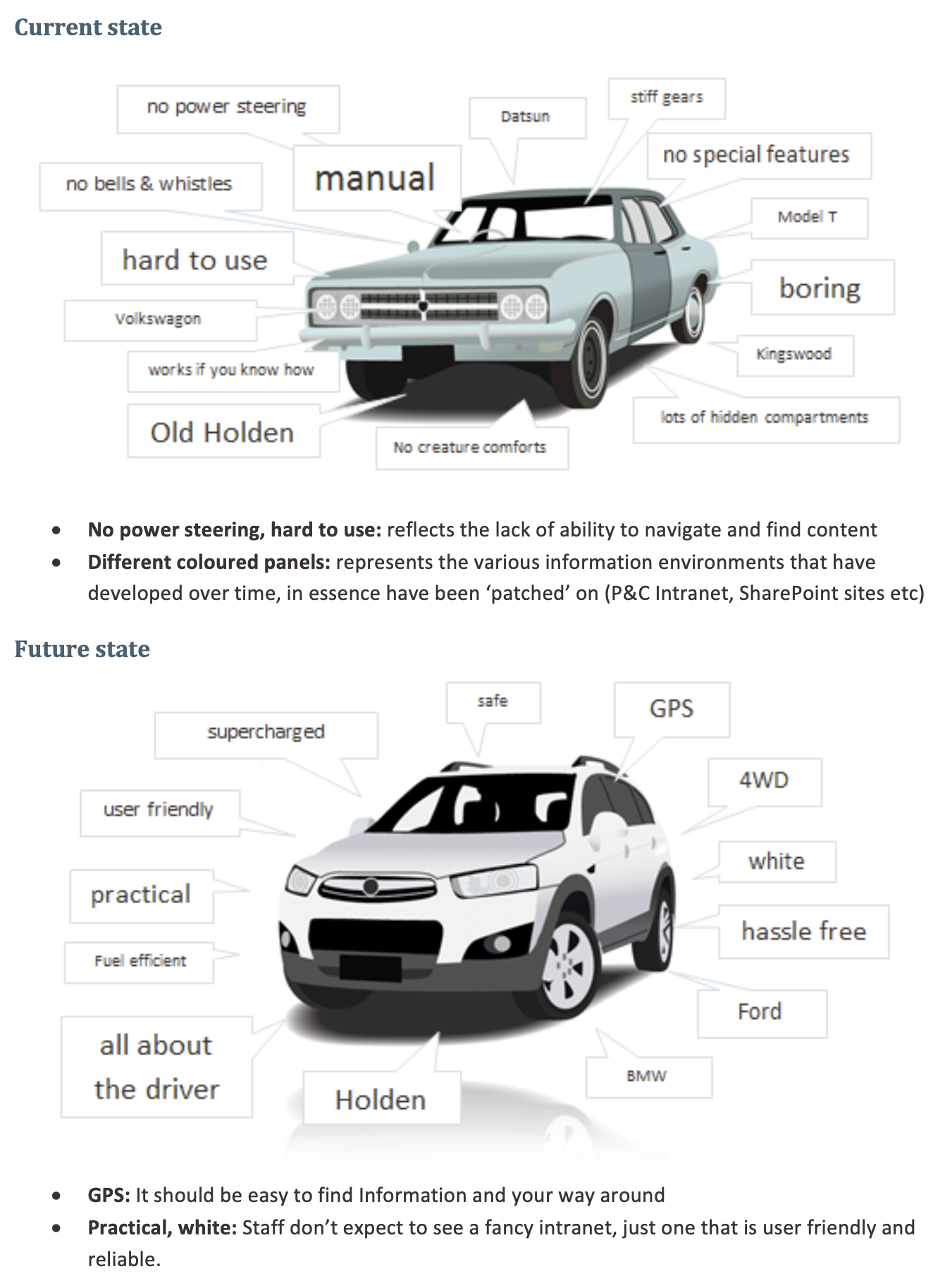
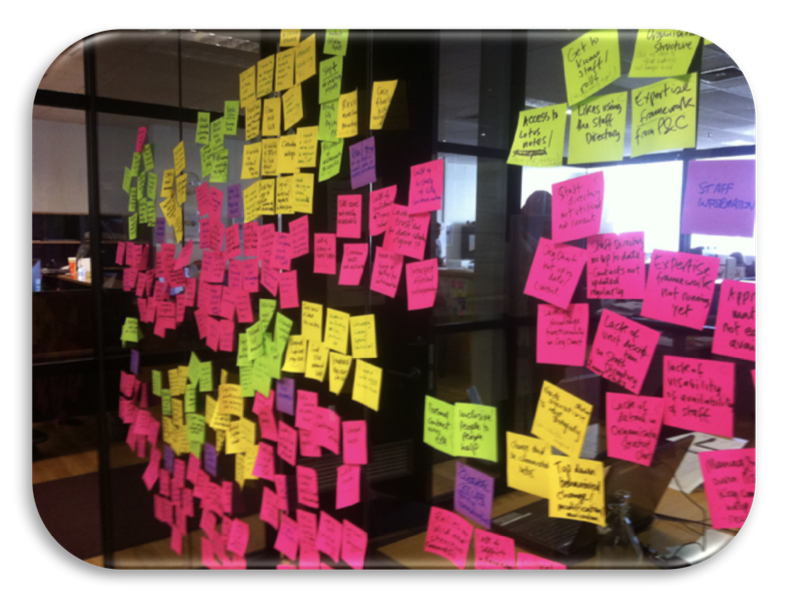
Stakeholder workshops using structured sense-making exercises (e.g., the “Cars” exercise) to surface shared mental models of current and future state
Quantitative Methods
Organization-wide intranet survey (109 respondents)
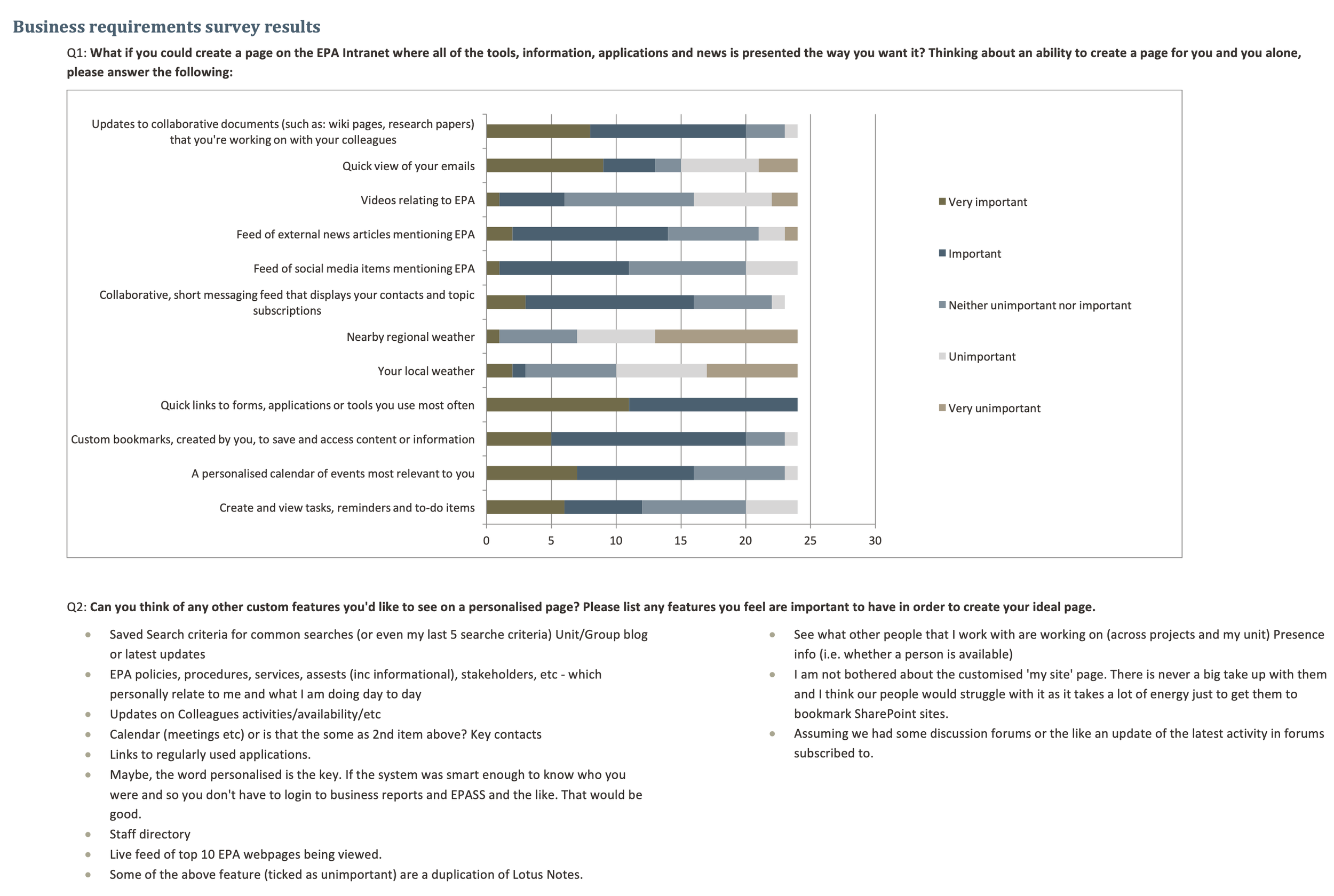
Business requirements survey (25 respondents)
Analysis of task frequency, information access patterns, and reported failure points
Review of documented operational risks related to information management (including external reports on data and document proliferation)
Together, these methods enabled triangulation between lived experience, reported behavior, and organizational risk indicators, establishing a rigorous mixed-methods foundation.
Key Insight
The most critical insight was that the intranet’s failure was structural, not cosmetic.
The system lacked:
a clear purpose
a shared definition of success
governance for content and ownership
alignment to real user tasks
As a result, the intranet attempted to be “everything to everyone” and became functionally unusable for most users.
This reframed the problem:
An intranet is not a website—it is organizational infrastructure.
Without treating information, collaboration, and task support as interdependent system components, no amount of interface improvement would succeed.
Design Artifacts
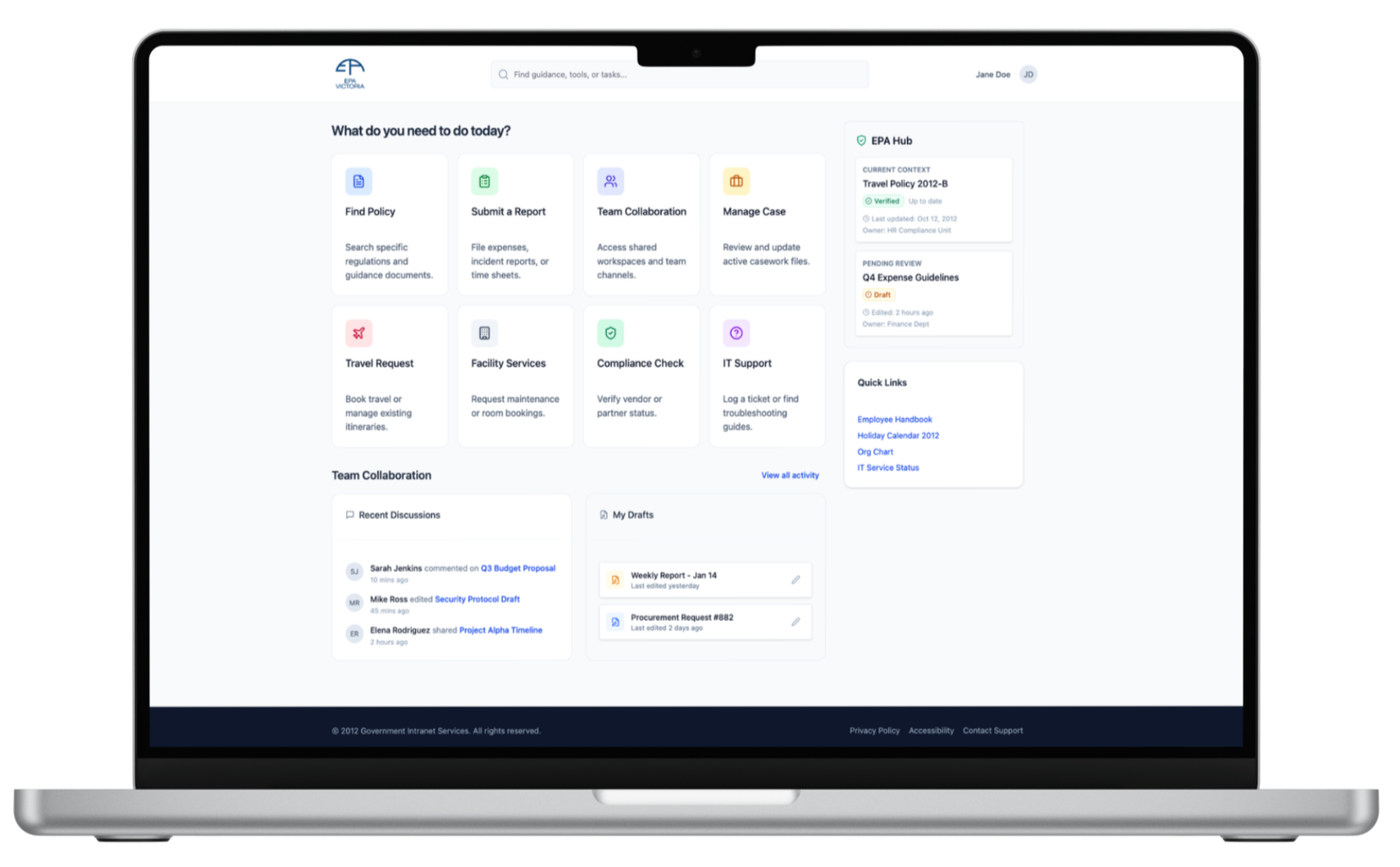
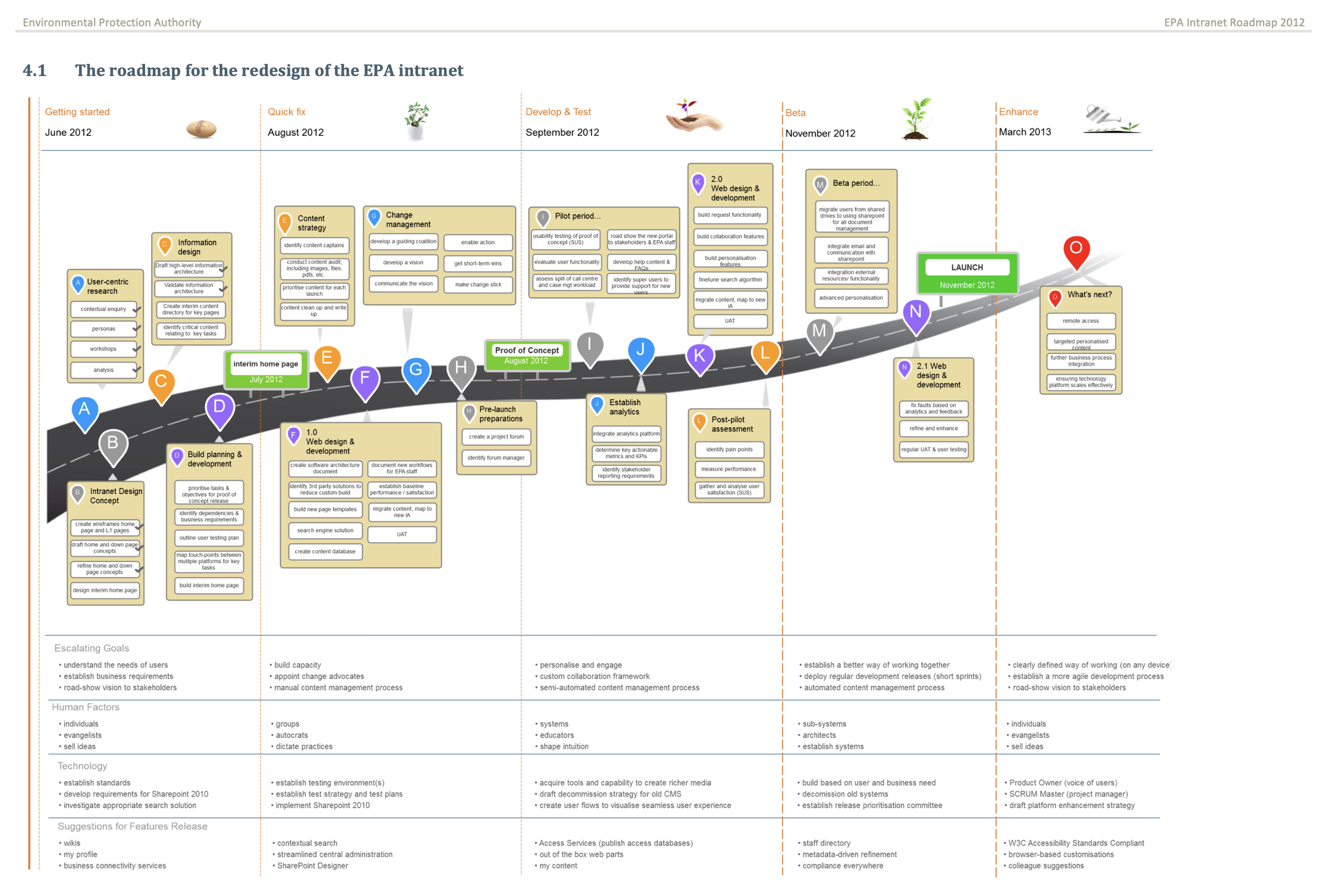
Rather than proposing a single redesign, the work produced a roadmap as a design artifact—a structured, phased representation of how the intranet should evolve over time in response to user needs, policy constraints, and organizational change.
Artifact 1: Task-Oriented Intranet Vision
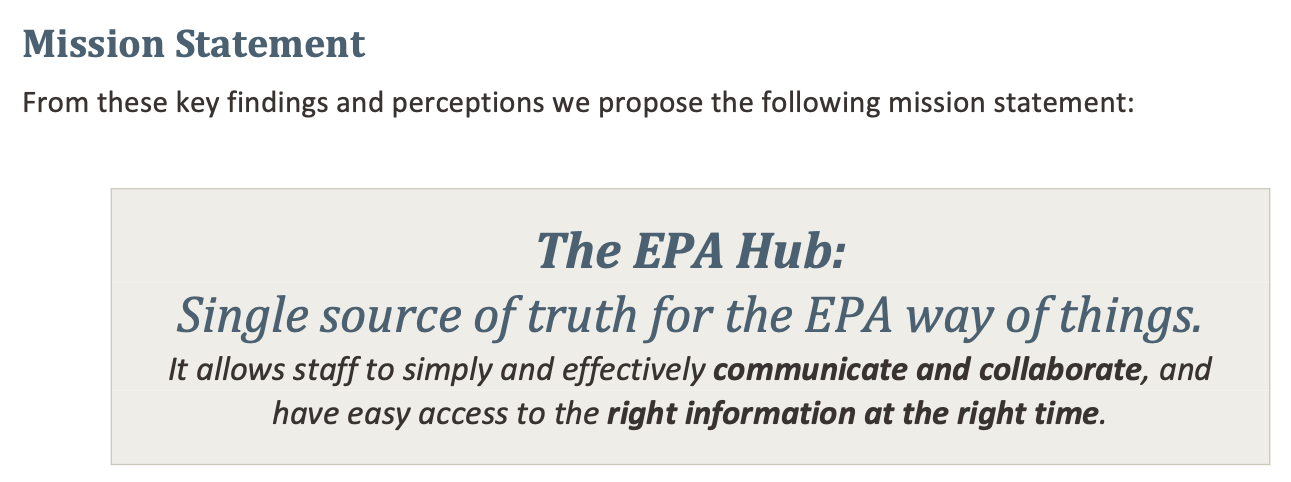
A new mission was defined for the intranet as a single source of truth that:
enables staff to communicate and collaborate effectively
provides access to accurate information at the point of need
supports real work tasks rather than content browsing
Artifact 2: Personas & Task Models
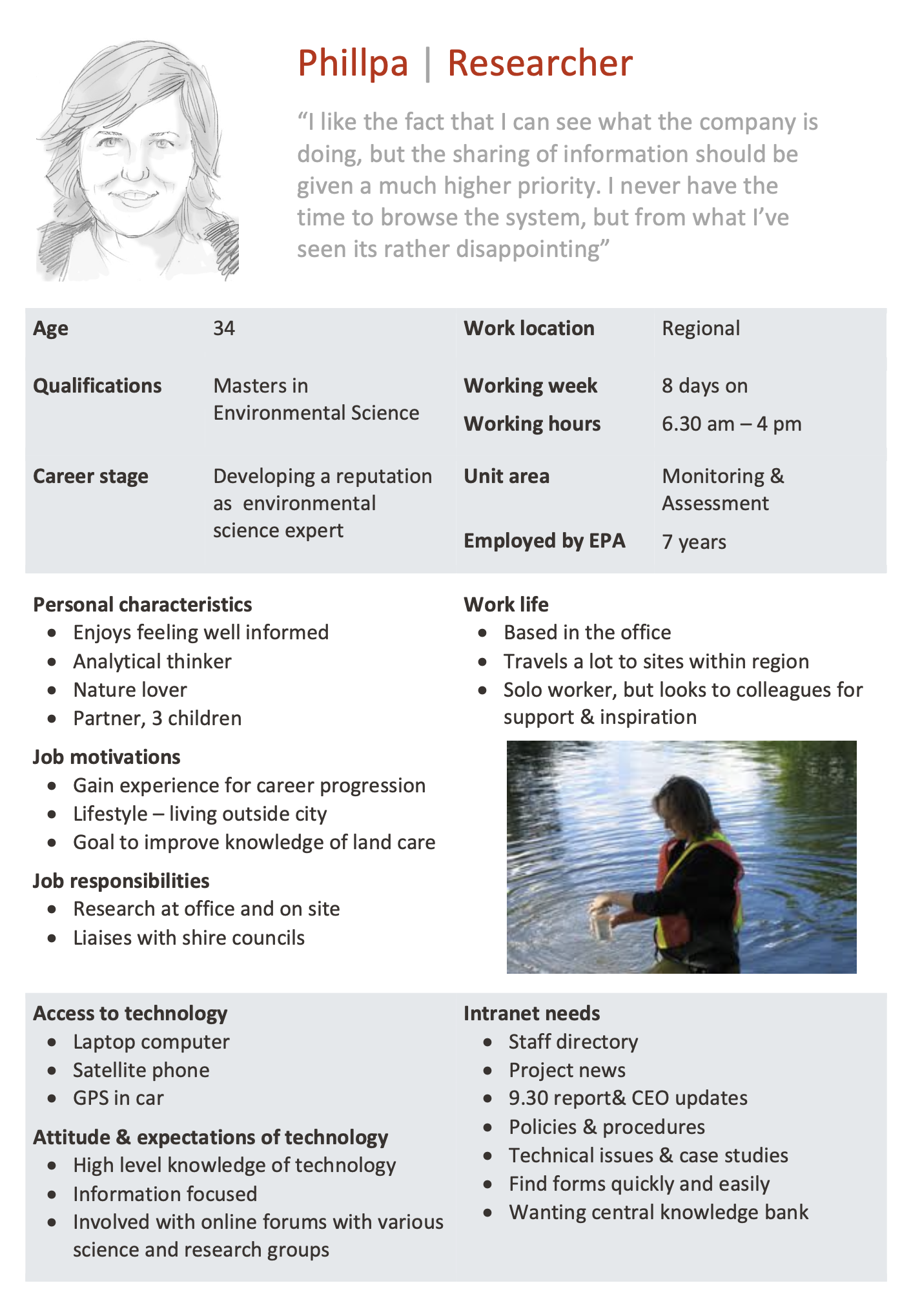
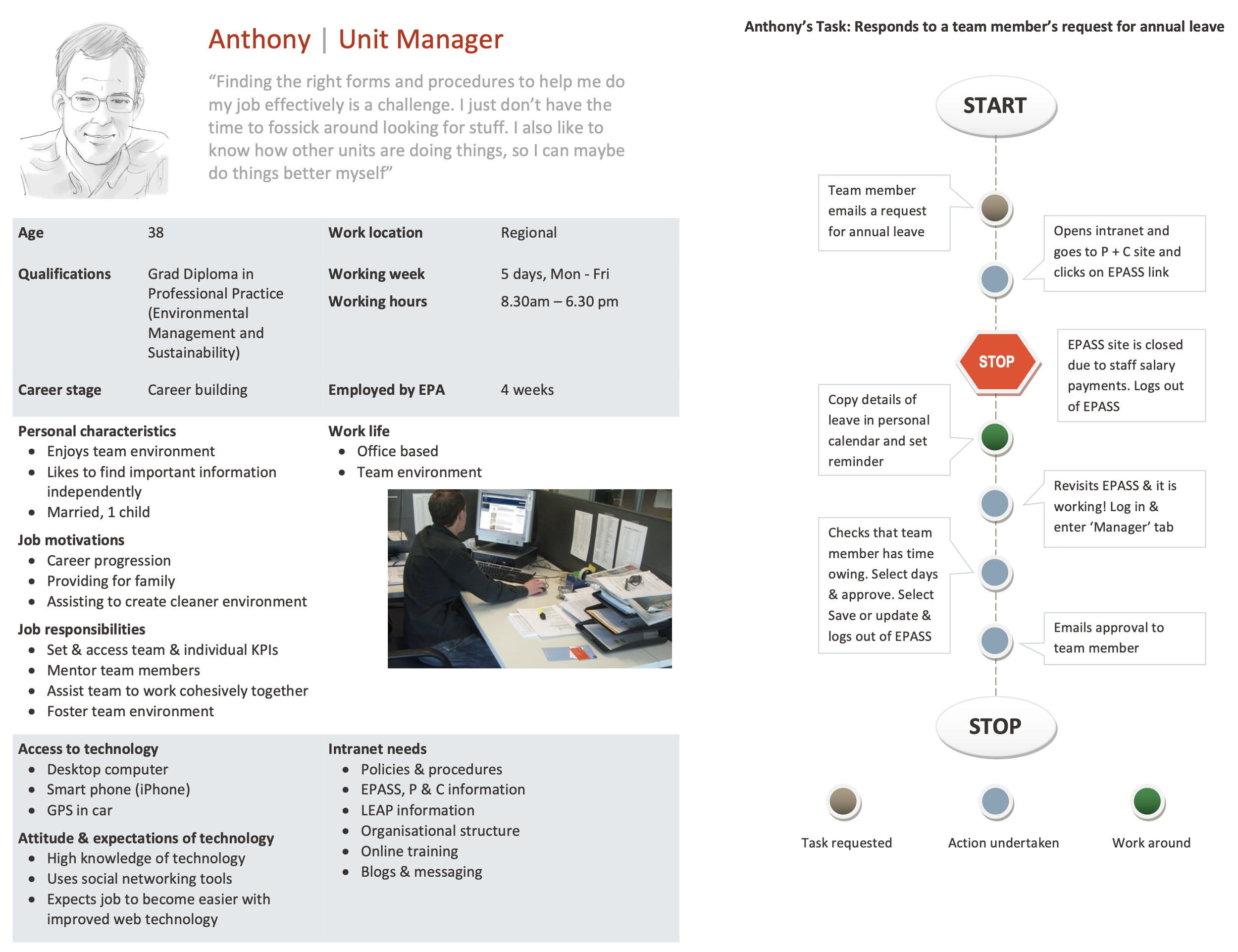
Nine personas were developed representing both generic and role-specific users (e.g., new starters, field officers, executives, researchers, administrators). Each persona was grounded in real task journeys that highlighted breakdowns, workarounds, and risk points
These personas functioned as analytic instruments, not marketing profiles—used to reason about task design, access needs, and system priorities.
Artifact 3: Phased Intranet Roadmap
A multi-phase roadmap was designed to:
deliver immediate “quick wins” (content strategy, IA improvements)
establish governance and standards early
progressively introduce collaboration, analytics, and personalization
remain adaptable to policy and legislative change
The roadmap explicitly balanced user value, organizational readiness, and implementation feasibility.
Artifact 4: Shared Information Architecture as a Common Language
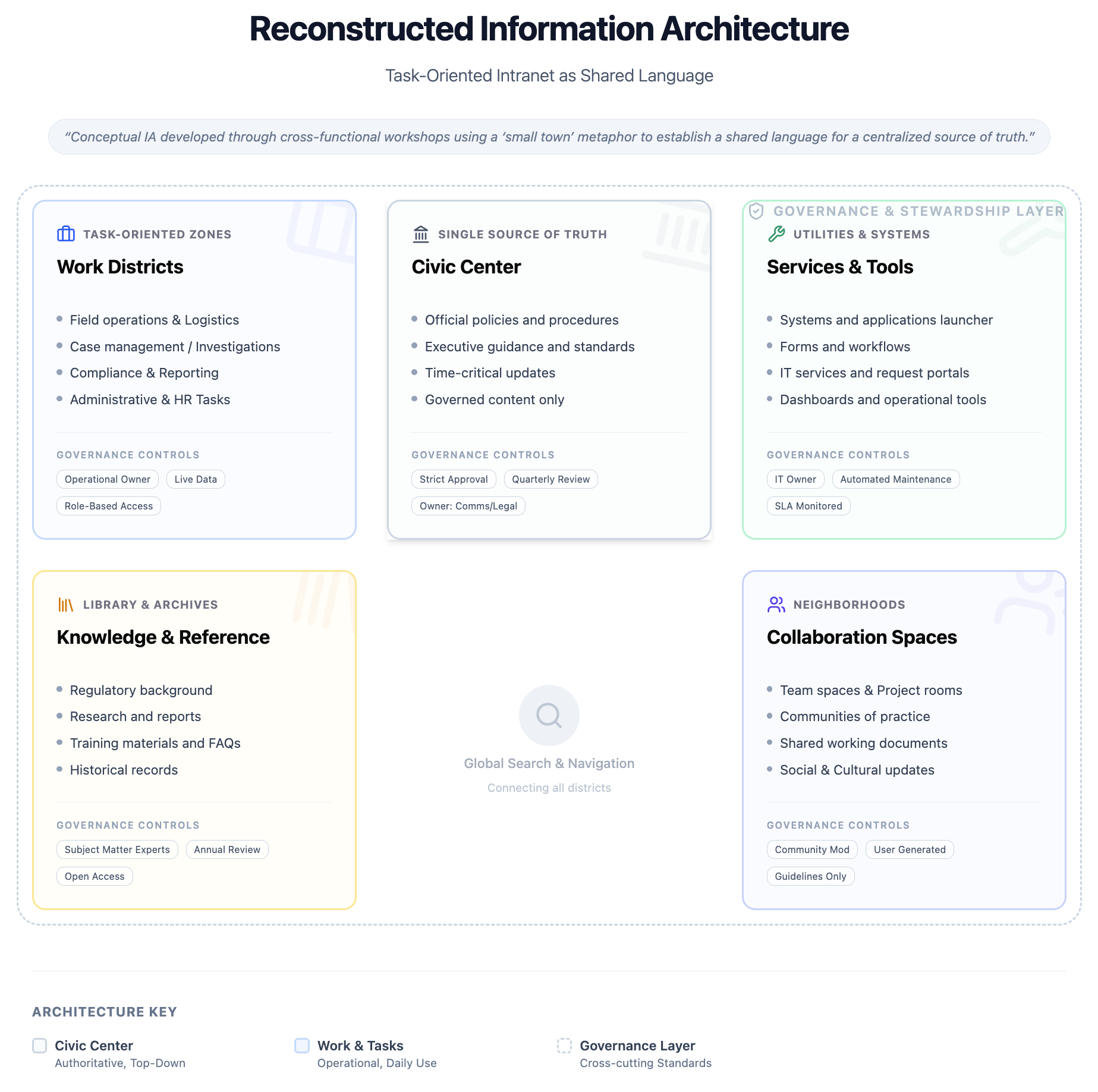
The redefined Information Architecture (IA) functioned not only as a navigation structure but also as a shared conceptual model for how the organization understood, governed, and used information.
The IA was the most challenging and impactful deliverable of the engagement. It took the form of a full-scale, spatially mapped model—so large that it covered all four walls of my workspace during synthesis. This physical scale was intentional: it allowed competing perspectives, content domains, and workflows to be seen simultaneously, revealing duplication, gaps, and misalignment that were invisible in siloed documentation.
When presented to the client, the IA was cited as the moment when the organization finally had a shared language for a centralized source of truth.
Resulting IA Characteristics
The resulting IA:
Organized information around work and intent, not organizational hierarchy
Explicitly distinguished between:
authoritative content
collaborative spaces
task-supporting resources
Embedded content ownership and governance directly into the structure
Reduced duplication by clarifying where information should live
Provided a stable foundation for future search, analytics, and personalization
Rather than optimizing for navigation alone, the IA functioned as infrastructure for shared understanding.

Disclaimer: This image is a stock photo used to demonstrate the metaphor of a small town in Australia.
How the IA Was Created (Methodological Rigor)
Cross-Functional IA Workshop Using a “Small Town” Metaphor
To break entrenched silos and policy-driven thinking, I facilitated a cross-functional workshop with subject-matter experts, using the metaphor of a small town to reason about shared digital spaces.
Participants were asked to collaboratively answer questions such as:
What functions belong in shared civic spaces versus specialized buildings?
Where do people naturally go when they don’t know where to start?
What spaces require governance, and which thrive on contribution?
What happens when information “lives” in the wrong part of town?
This metaphor allowed stakeholders to reason about:
public vs restricted information
official guidance vs working knowledge
ownership and stewardship
pathways between tasks, people, and information
Crucially, it shifted the conversation away from pages and folders toward purpose, behavior, and trust.
Evaluation & Validation
Evaluation occurred through:
stakeholder validation workshops
cross-role review of personas and task flows
alignment checks against business drivers and risk indicators
executive sign-off on roadmap priorities
Importantly, the roadmap itself was treated as a living evaluative artifact, designed to be revisited and adjusted as organizational conditions evolved
Design Science Contribution
This case demonstrates several transferable design science contributions:
Intranets as Socio-Technical Systems
Effective intranets must be designed as infrastructure supporting tasks, governance, and trust—not as content repositories.Roadmaps as Knowledge Artifacts
A roadmap can function as a design artifact that encodes theory, user insight, and organizational constraints.Personas as Analytical Tools
When grounded in task analysis, personas enable system-level reasoning rather than surface-level empathy.Design Under Policy Constraint
Public-sector systems require adaptability to legislative and political change; design must explicitly accommodate this reality.
What This Work Enabled
The roadmap provided EPA with:
a shared vision and vocabulary for intranet improvement
a structured path from fragmentation to coherence
a foundation for governance, analytics, and future capability building
reduced operational risk associated with unmanaged information
Reflection
This project reinforced a principle that continues to shape my work:
Design impact in complex organizations comes from shaping systems, not just interfaces.
By grounding design decisions in mixed-methods research and encoding them into durable artifacts, this work helped reposition the intranet as a strategic asset rather than a neglected tool